 Hüpattl! Software
To Boldly Glow — Voyager: Two Lessons, Two Tours Beta
Until now To Boldly Glow showed the Sun, the planets and their moons. Now the first spacecraft joins them, two at once: Voyager 1 and 2, launched in 1977, both still sending data home. I did not want to show them rebuilt, but as real as I could: with NASA's own 3D model, their actual trajectories, the photos the probes took themselves, and the measurements with which Voyager 1 reached interstellar space in 2012.
Two lessons
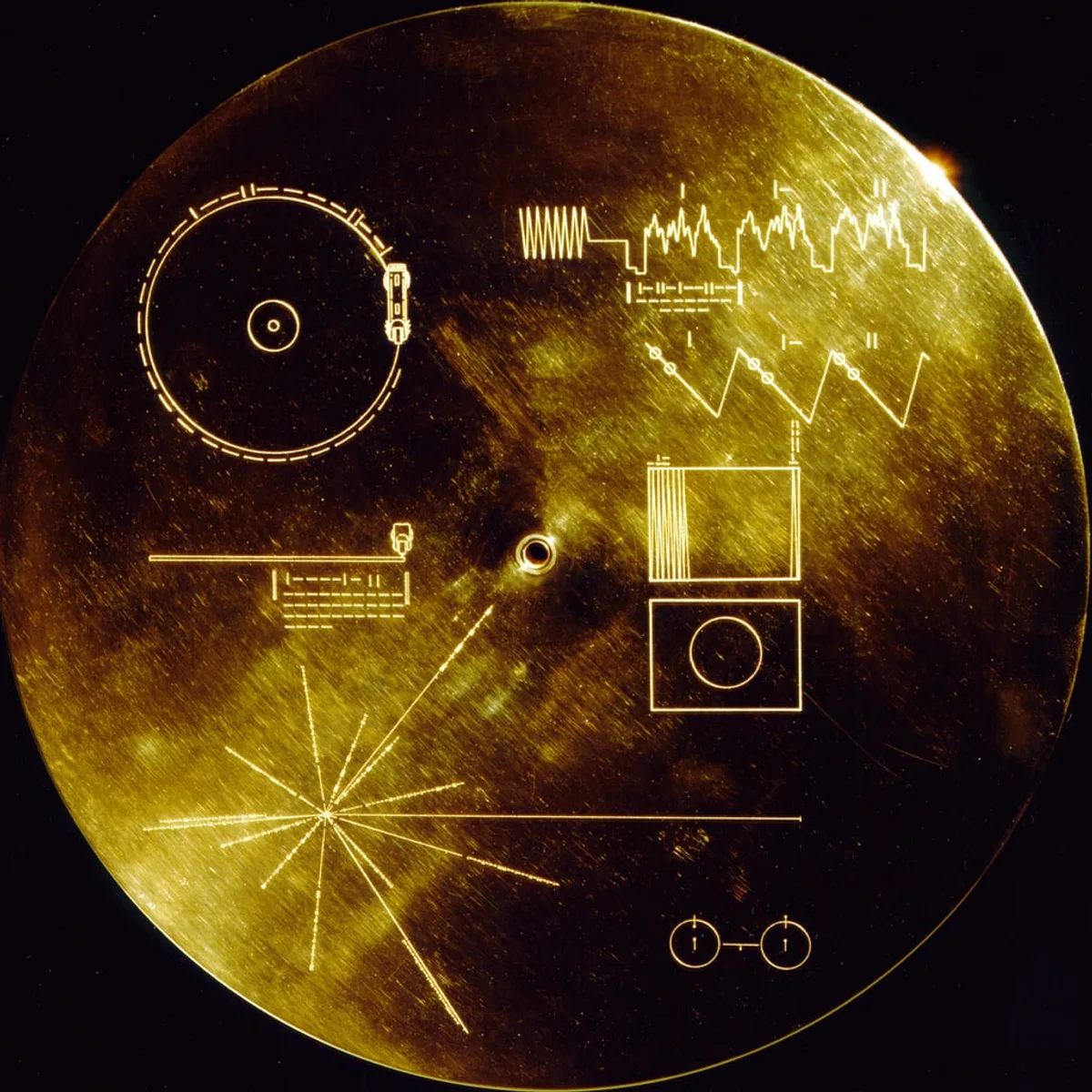
Learn has a new shelf, Missions. “Voyager: the farthest journey” is for everyone: the probe turning slowly, what is on board, the Golden Record and the instructions on its cover, then the route through the real solar system, from the rare alignment of the planets in the 1970s out to interstellar space.
“Voyager in depth” goes further: the probe taken apart into its assemblies, power from plutonium, a 23-watt transmitter, eleven instruments, and two charts of real data. One shows Voyager 2 gaining speed at each planet until it is faster than it needs to leave the solar system. The other shows the day Voyager 1 left the heliosphere: the particles from the solar wind's bubble all but vanish, and the magnetic field jumps.
One chapter shows how the record stores its 115 pictures: as sound, line by line. A test picture of our own goes through the same steps, and you can listen to its signal. The record's own pictures and music are not included; they belong to their creators. A marked link leads to NASA, where they can be seen and heard.
Two tours
Beside the grand tour, Tours has two new ones: “Voyager 1: Jupiter, Saturn – and first into interstellar space” and “Voyager 2: all four giant planets”. They follow the probe from 1977 to today. Time races between the stations and slows down before each one. At every planet the picture changes to a flyby at true scale: planet, moon and path at their real sizes and distances, the camera riding behind the probe as the planet sweeps past. Only the probe itself is enlarged; at 4 metres it would be invisible next to Saturn.
Each station has a card with the date, the distance and the signal's travel time, a photo the probe took or a chart, and what was found there: volcanoes on Io, Titan's haze, Neptune's Great Dark Spot, geysers on Triton. A timeline at the bottom shows all stations; a click jumps there, pause holds everything.
In the explore view
Both probes now also stand in the explore view at their real places on the date shown, as 3D models with their dishes turned toward Earth. Find has a Spacecraft group for them; a click flies there and follows the probe.
Real, and all in the app
- The model is NASA's “Voyager Probe (B)” from NASA 3D Resources, converted and taken apart into its assemblies.
- The trajectories come from JPL Horizons: daily from 1977 to 2030 for the route, every five minutes at true scale for each flyby. At all six flybys they lie on the app's planet positions; a test checks it.
- The heliopause measurements come from NASA's Space Physics Data Facility, the photos from NASA/JPL's Photojournal.
- Everything is in the app, about 1.5 MB, and loads only when you open a Voyager lesson or tour. None of it comes from the internet while you use it; the only way out is the marked link to NASA.
- The narration is by the same two synthetic voices as the grand tour, Lyra and Orion, in English and German. This time I made the new recordings on my own GPU machine at home instead of the Mac; again, nothing went to a cloud service.
Smaller things
- Playing lessons: a new button in the lesson dock turns the page by itself once a chapter has been read out.
- Controls: the About dialog now explains, for mouse, trackpad, touch and keyboard, what does what when orbiting, in free flight, and in lessons and tours.
Try it
Start it, then Learn → Missions or Tours → Voyager. The product page has more pictures. If something does not work the way you expect, tell me on GitHub.