
BeOS
an introductory overview
A small introduction on the operating system BeOS. Although Be Inc. is not anymore, it is still worth to mention.
1.0 introduction > top of page
1.1 history > top of page
BeOS is developed and distributed by Be Inc. CEO Jean Grassé was employee at Apple in previous times and was co-developer of the famous MacOS. Back in 1986, Grassé already had an idea of BeOS, but he had to wait four more years to realize his idea. In 1990 he founded Be Inc. along with a hand full of other programmers and the first kernel and parts of the whole OS got shape.
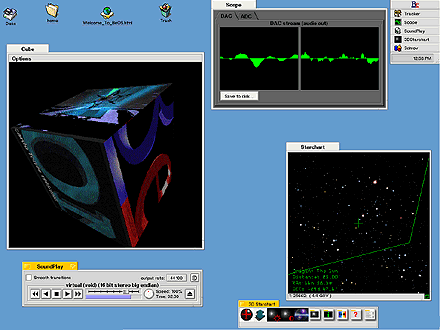
Pic 1: high performance multimedia (click to enlarge)
2.0 features > top of page
2.1 general > top of page
BeOS plays a special role between the other OSs, cos it does not base on old stuff - MacOS, Windows and the diverse UNIXs suffer from code that have their origin in the late 60s, 70s and 80s. But BeOS has been developed from scratch. Being a new star on stage, BeOS was not that exotic as one might think - it is fully POSIX conform and is a strong UNIX look-a-like (there is even a built-in bash!).
Beside BeOS that new operating system is also entitled "Media OS", cos the lean architecture with low overhead allows fast processing - not only in a multimedia sense.
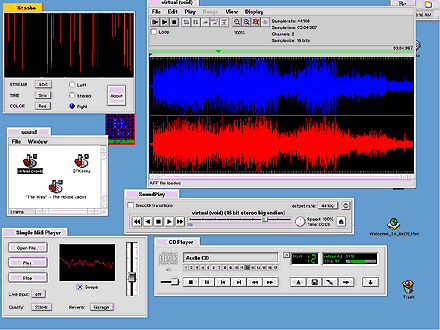
Pic 2: BeOS' excellent realtime processing (click to enlarge)
The intention of BeOS is not to fight for the crown - no, BeOS wants to be seen as addition to existing ones. It can share a system along other OSs without problems; other file systems can be mounted into the Be File System BeFS (FAT 16, FAT 32, NTFS, HFS, HPFS, ext2fs, Reiser FS).
The developers took a look beyond their desktops and observed other operating systems during the conception phase. As a consequence, you have a GUI similar to Windows, KDE and MacOS but the internal features of UNIX bound with the stability of NT and UNIX. Of course, BeOS is not simply a mix of other OSs; more likely it has its own identity and ideas.
2.2 cooperative OS > top of page
- BeOS can be installed within an existing file system (since version 5.0) or within its own partition
- external file systems can be mounted: FAT, NTFS, HFS, ext2fs/Reiser FS
- standard file formats supported: AVI, MPEG, Wave, QuickTime, MIDI etc.
- runs on Intel compatible (x86) or PowerMac platforms
2.3 high performance > top of page
- truly multiprocessed / -threaded plus multiprocessor support (up to four CPUs)
- lean kernel and minimal code overhead
- optimized use of available resources
- support of accelerated hardware
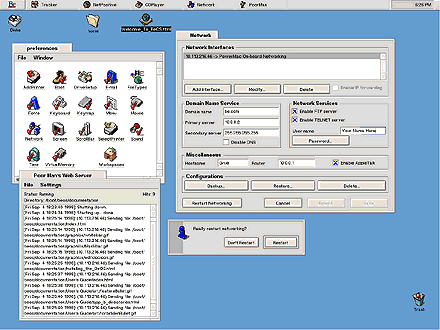
Pic 3: easy to handle hardware management (click to enlarge)
2.4 filesystem > top of page
- 64bit journaled filesystem
- file identification via MIME types
- dynamic file attributes, may even be binary data
- can be seen as a database (capable of creating tables and queries)
- file and partition sizes up to some terrabytes
- other file systems can be dynamically linked into (mounting)
2.5 communication > top of page
- as common in UNIX, miscellaneous networking services are integrated: ftp, http, telnet, nntp, smtp, pop3 and more
2.6 portability > top of page
- BeOS applications are binary compatible with Linux, Free~/Open~/NetBSD etc. (ELF); most sources can be compiled on BeOS using gcc
2.7 miscellaneous > top of page
On the other hand, BeOS has to suffer from well-known problems: lack of drivers. Hardware vendors mostly create their drivers for Windows only.
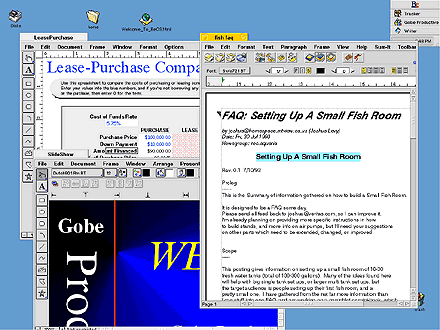
Pic 4: office is not an alien thing to BeOS (click to enlarge)
Another problem is the little amount of BeOS users. In mid 1999, the total number was estimated to approximately 1 million; less than a third of private Linux users at that time. As a result, there is little software available.
Nevertheless, there already is known software available: Netscape Communicator, RealPlayer G3, Bryce 3D, Steinberg Nuendo and more. Important games: Quake2, Descent, Doom...
Copyleft (C)2001 by Blazko. This document is licensed under the terms of the GPL.